


Portable Car Jump Starter Industry Trend 2026 shows that portable jump starters are evolving from single-purpose emergency tools into multi-function power hubs, driven by global vehicle growth, lithium battery innovation, and changing consumer behavior.
Market Foundation & Historical Review (2020-2025): Value Chain Reshaping & High-Growth Engines
The Strategic Position of Portable Jump Starters: From Emergency Tool to Multi-Function Power Hub
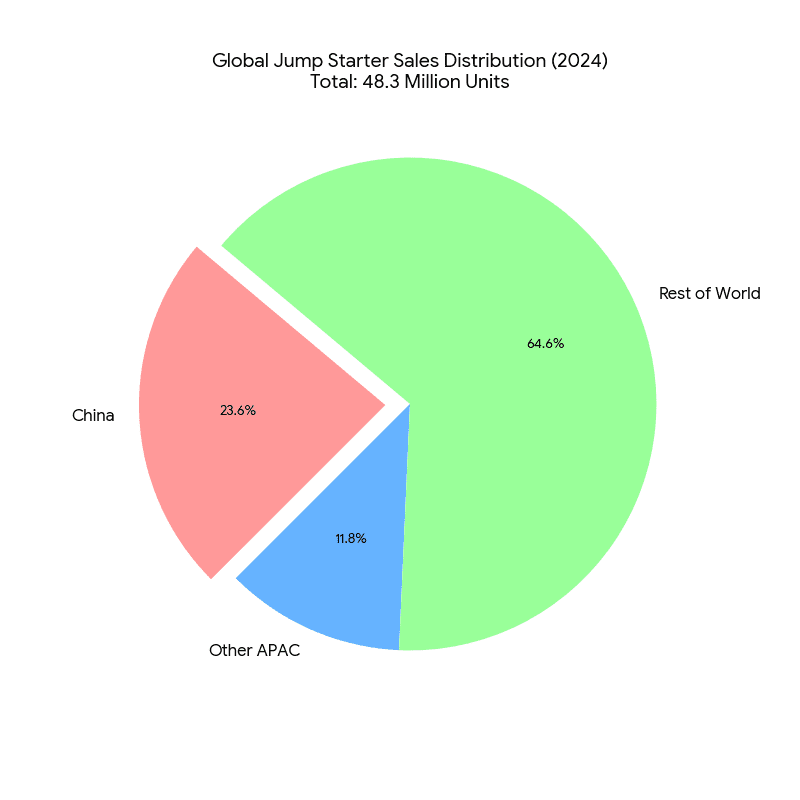
Portable car jump starters are playing an increasingly vital role in the global automotive aftermarket. The fundamental drivers of demand growth are the continuous rise in global vehicle parc and the consequent increase in vehicle battery failure incidents. Statistics show that in 2024 alone, over 74.8 million vehicles worldwide experienced battery-related starting issues, directly driving the sales of more than 48.3 million jump starters.
This product has transcended its traditional definition as an “emergency tool” and is evolving into an essential multi-function power hub in the personal vehicle owner’s toolkit. Consumers are increasingly inclined towards “Do-It-Yourself” (DIY) solutions for vehicle maintenance, while heightened awareness of vehicle safety and reliability further solidifies the jump starter’s status as emergency equipment. Moreover, market expectations have expanded from the singular “starting” function to integrated applications like USB charging, emergency lighting, and even air compressors. By incorporating these additional features, manufacturers have successfully tapped into the modern consumer psychology of seeking “all-in-one” devices and maximizing utility value.
Market Size Retrospective: Identifying the High-Growth Power Source
Analyzing market data from 2020 to 2025 reveals steady growth in the overall global jump starter market, but with significant growth disparities across different market segments. This differentiation is crucial for understanding the market direction in 2026.
This stark contrast uncovers a significant market reshaping: the real growth engine stems not from traditional automotive maintenance needs, but from the convergence of consumer electronics and outdoor emergency power demands. Consumers increasingly view jump starters as “high-power power banks,” with the car-starting function being a key high-value-added service. This high growth is concentrated in lithium-ion battery-driven, lightweight, multi-functional consumer-grade products.
Market Segmentation & Growth Differential Comparison (2024-2033)
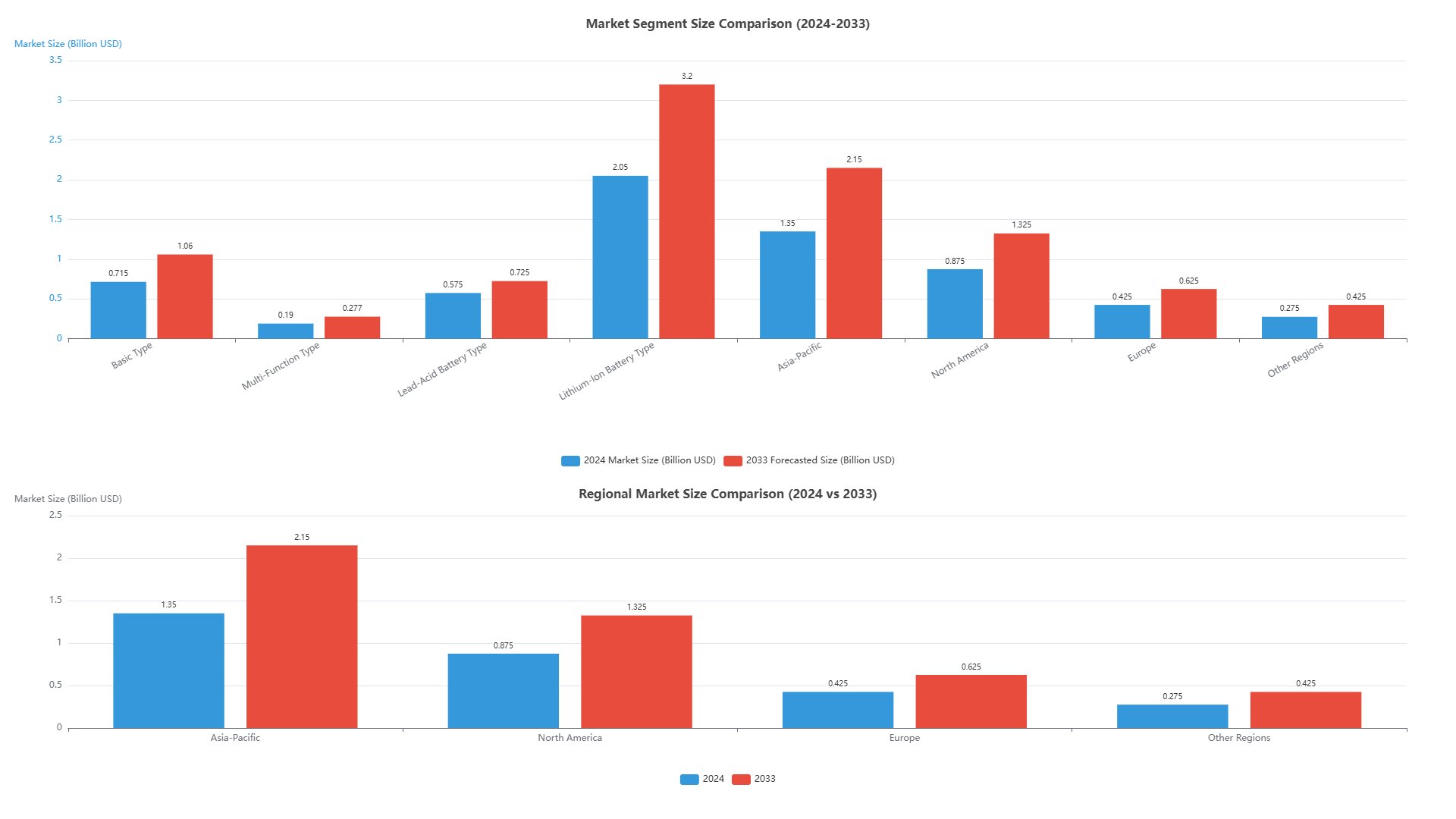
| Market Segmentation Dimension | Segment Type | 2024 Market Size (USD) | 2033 Forecasted Market Size (USD) | Compound Annual Growth Rate (CAGR) | Core Growth Drivers | Target Customer Groups |
|---|---|---|---|---|---|---|
| Product Function | Basic Type (Emergency Start Only) | 0.68-0.75 Billion | 1.02-1.10 Billion | 1.7%-3.8% | Rigid demand from traditional auto repair shops and professional rescue agencies | Auto repair enterprises, road rescue service providers |
| Multi-Function Type (Integrated with Power Bank/Emergency Lighting/Air Compressor) | 0.18-0.20 Billion | 277 Million | 7.2%-9.1% | Convergence of consumer electronics and outdoor emergency power demands, DIY maintenance trend | Private car owners, outdoor enthusiasts, self-driving travelers | |
| Battery Type | Lead-Acid Battery Type | 0.55-0.60 Billion | 0.70-0.75 Billion | 1.5%-2.5% | Cost advantage, compatibility with some commercial vehicles | Truck fleets, owners of old-model vehicles |
| Lithium-Ion Battery Type | 2.00-2.10 Billion | 3.15-3.25 Billion | 7.0%-9.5% | Lightweight design, long battery life, multi-scenario adaptability | Household car owners, users with portability needs | |
| Regional Market | Asia-Pacific Region | 1.30-1.40 Billion | 2.10-2.20 Billion | 6.5%-8.5% | Surging vehicle ownership in emerging economies, rising penetration rate of consumer electronics | Car owners in China, India and Southeast Asia |
| North America Region | 0.85-0.90 Billion | 1.30-1.35 Billion | 5.0%-6.5% | Mature automotive aftermarket, strong DIY maintenance culture | Household users in the United States and Canada | |
| Europe Region | 0.40-0.45 Billion | 0.60-0.65 Billion | 4.5%-5.5% | Supporting demand for new energy vehicles, enhanced awareness of emergency safety | Private car owners and new energy vehicle users in EU countries | |
| Other Regions (Middle East/Africa/Latin America) | 0.25-0.30 Billion | 0.40-0.45 Billion | 5.5%-7.0% | Rising vehicle sales driven by economic development, gradual improvement of infrastructure | Local emerging middle class, self-driving tourism groups | |
| Overall Market | 2.50 Billion | 3.90 Billion | 5.4% | Integration of consumer electronics and demand in the automotive aftermarket | All customer groups |
Technological Innovation: The Battery Tech War
The core technological competition in portable jump starters centers on battery type. The market is shifting from traditional lead-acid technology towards high-performance lithium-ion and beginning to explore the emerging path of supercapacitors.
Lithium-Ion Batteries: Performance, Lightweight, and Challenges
Lithium-ion (Li-ion) batteries are undoubtedly the dominant force. In 2023, Li-ion-based jump starters contributed about 65% of market revenue and achieved global sales of 29.6 million units in 2024. Their core advantages are high energy density, lightweight, fast charging, and low self-discharge rate, greatly meeting consumer demand for compact design and convenience.
Lead-Acid Batteries: Persistence in Professional and High-CCA Domains
Despite the growing popularity of Li-ion, lead-acid batteries maintain competitiveness in certain segments due to historical reliability and stable Cold Cranking Amps (CCA) delivery. According to 2025 estimates, lead-acid jump starters still hold the highest market share at 54.9%, primarily in professional repair, fleet management, and heavy machinery sectors demanding extreme reliability.
Their limitations are significant: lead-acid starters are heavy, bulky, and must be kept fully charged for optimal performance. As Li-ion technology matures and costs decline, the application domain for lead-acid is gradually shrinking.
Future Trend: The Rise and Market Positioning of Supercapacitor Technology
Looking towards 2026 and beyond, supercapacitor technology promises disruptive changes in high-end and professional segments. Supercapacitors, positioned between traditional capacitors and batteries, offer significant advantages including exceptional thermal stability, ultra-long lifespan (over 100,000 cycles), and maintenance-free operation. Particularly in extreme cold, their starting performance far exceeds that of Li-ion, addressing a key Li-ion pain point.
Although initial costs are typically higher, analysis suggests that in applications demanding ultimate starting reliability—such as professional fleets, heavy-duty diesel vehicles, or extreme cold climates—the super-long lifespan and maintenance-free nature can significantly lower the total cost of ownership, making them more economical than frequently replaced Li-ion units. Therefore, in 2026, supercapacitors will become a key technology for differentiated competition in high-end, professional, and extreme-cold markets, creating clear segmentation from Li-ion in the mass consumer market.
Evolution of Technical Safety: From Basic Protection to Smart Reverse Polarity/Overheat Management
Safety is a core competitive edge. Improper use of traditional jumper cables can cause reverse polarity, damaging the vehicle’s alternator or electronics, or even cause explosions from sparks igniting battery-released hydrogen.
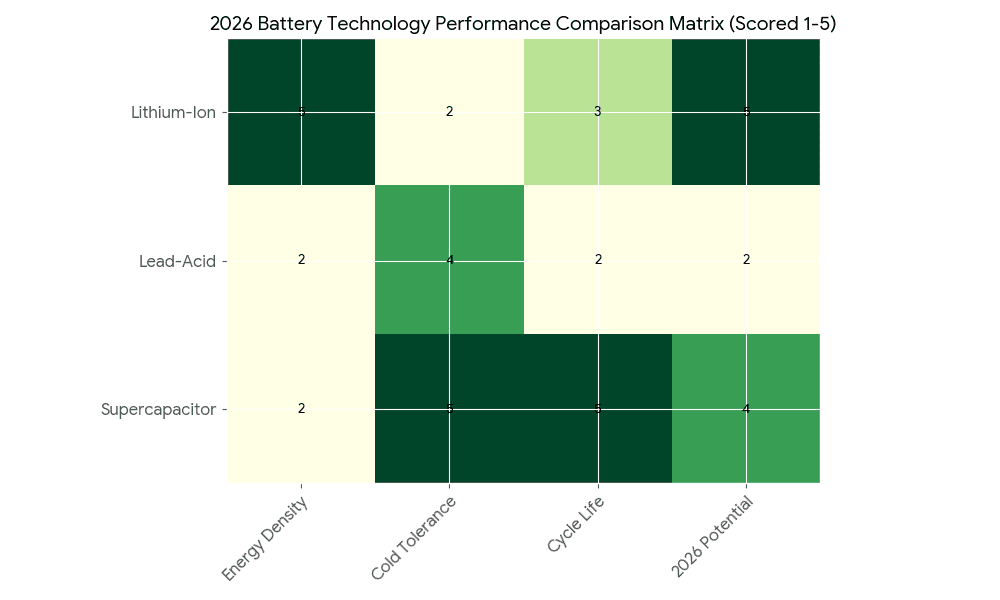
Core Battery Technology Comparison: Performance, Cost & 2026 Application Potential
| Technology Type | Lithium-Ion (Li-ion) | Lead-Acid | Supercapacitor |
|---|---|---|---|
| Energy Density/Weight | High energy density, lightweight | Low energy density, heavy/bulky | Low energy density, but high instantaneous power |
| Cold Cranking/Temp Tolerance | Susceptible to extreme cold | Reliable, high CCA | Excellent temperature stability |
| Cycle Life & Storage | 3-5 years requires charge state management |
Shorter requires monthly full charge |
Extremely long life (100k+ cycles), maintenance-free |
| 2026 Market Positioning | Mass consumer, multi-function integration | Traditional professional use, heavy machinery | High-end professional, extreme cold regions, high reliability |
Consumer Demand & "Google Trends" Search Insights (Consumer-Driven Innovation)
Analysis of search trends and consumer feedback for portable jump starter-related keywords indicates that purchase intent is no longer solely price-focused but prioritizes product practicality, reliability, and feature integration.
Consumer Search Focus & Pain Point Analysis
- Starting Performance & Compatibility: Consumers seek products capable of starting large displacement engines (e.g., compatible with 8.0L gasoline or 6.0L diesel), like the Avapow 6000A or NOCO Boost Pro 10. The core metric has shifted from abstract “amp ratings” to practical “starting capability.”
- Brand Trust & Reputation: Brands with strong word-of-mouth, like NOCO Boost series, GooLoo, and professional Jump-N-Carry, enjoy high exposure and positive reviews, showing brand trust is decisive in emergency product purchases.
- Multi-Function Integration: Search focus is on products with added features like built-in air compressors, USB-C PD ports, and LED lighting.
Product Function Integration: Air Compressor, PD Fast Charging & Smart Display
- Air Compressor: Integrating a jump starter with an air compressor creates a complete roadside emergency kit, addressing concurrent tire inflation needs.
- USB-C PD Fast Charging: Consumers increasingly rely on jump starters as emergency power for electronics. High-wattage USB Type-C PD fast charging and multiple output ports are becoming industry standards. This not only speeds up device self-charging but also enables charging for modern high-power devices like laptops and tablets, deepening integration with daily electronics use.
Brand Loyalty & Competitive Logic
2026 Product & Design Trend Forecast: Miniaturization & Intelligence
Trend 1: Balancing Ultra-High Capacity & Miniaturization (High Energy Density)
Trend 2: Intelligent Connected Function Integration (App Monitoring & Fault Early Warning)
Trend 3: 12V Auxiliary Power Solutions for New Energy Vehicles (NEVs)
Trend 4: Design Aesthetics, IP Ratings & Extreme Environment Adaptability
2026 Portable Jump Starter Key Function Integration Forecast

| Function Integration Module | 2024 Market Status | 2026 Trend Prediction | Consumer Value & Traffic Driver |
|---|---|---|---|
| Multi-Function Integration (USB/Air Compressor) | 42% of products integrated | Over 60% (becoming standard) | Maximizes utility, top choice for outdoor emergency |
| Intelligent Safety Protection (Reverse Polarity/Overheat) | Commonly integrated, varying precision | Hardware + software smart diagnostics/warnings | Extreme safety, reduces user concerns |
| USB-C PD Fast Charging | Popular in mid-high end | Widespread adoption (25W-100W PD) | Improves charging speed/efficiency, meets modern device needs |
| IoT/App Remote Monitoring | Only explored by few startups | Beginning penetration in high-end/pro markets | Predictive maintenance, real-time battery health awareness |
Global Market Landscape & Supply Chain Shifts
Regional Growth Hotspots: Analysis of Explosive Growth in Asia-Pacific
European Market Spotlight: Compliance Challenges of the EU New Battery Regulation (Regulation 2023/1542)
- Mandatory CE Marking: From August 18, 2024, manufacturers must affix the CE mark to batteries placed on the market, indicating compliance with EU safety, health, and environmental requirements.
- Sustainability & Recycled Content Requirements: The regulation sets minimum targets for recycled content. By 2031, batteries placed on the market must contain 6% to 85% recycled content for key materials like cobalt, lithium, nickel, and lead. These requirements will become mandatory for certain battery types from August 18, 2028.
- Collection Targets: Portable batteries have explicit collection targets: 63% by 2027 and 73% by 2030. This requires manufacturers and distributors to participate in more complex recycling systems and conduct supply chain due diligence to ensure raw material sourcing meets international standards.
Impact of Regulations on Cost & Production: Supply Chain Transparency
Furthermore, the regulation raises technical and compliance barriers. Large brands with mature supply chains and resources to meet sustainability requirements will benefit. Conversely, smaller manufacturers struggling to adapt may face elimination. Regulation-driven supply chain transparency and sustainability requirements are reshaping the industry’s competitive landscape.
2026 Competitive Landscape & Strategic Recommendations
Key Competitor Analysis: Market Share & Product Differentiation Strategies
- Technology Leaders: Maintain market leadership by continuously launching innovative products, having a comprehensive product line, and outstanding safety performance. Their strategy emphasizes technological advantage and user experience.
- Value Challengers: Challenge the mid-to-low-end and value segments by offering competitive pricing, high amp output, and integrated multi-functional designs.
- Professional/Traditional Market Defenders: Maintain a unique position in scenarios demanding ultimate reliability (heavy machinery, professional shops) using lead-acid or supercapacitor technology.
Retail Channel Changes: How E-commerce Reshapes Distribution Models
Brand Building & Marketing: Driving Traffic via Product Safety, Professionalism, and Multi-Functionality
Emphasize Safety Endorsement: Marketing content must highlight built-in intelligent safety systems and high-quality battery management technology. This is not only a basic feature but a key element in building consumer trust and differentiating from low-quality competitors.
Professionalism & Performance Verification: For high-end or professional-grade products, use detailed data and tests to prove performance in extreme environments.
Scenario-Based Marketing: Use scenarios like camping, road trips, and extreme weather preparedness to highlight the practical value of multi-function integration. Showcasing how the device integrates into consumers’ lifestyles and emergency needs maximizes the appeal of the “integrated power bank.”
Summary & 2026 Core Trend Focus
Three Core Conclusions for 2026: The Interplay of Technology, Market, and Regulations
-
Market Redefinition Towards “Power Bank”: High industry CAGR (7%-9%) will remain concentrated in the lithium-driven, multi-function integrated “Jump Starter Power Bank” segment. The mainstream positioning has shifted from a single emergency tool to an outdoor and in-vehicle power hub with high-power starting capability. This shift requires manufacturers to focus on portability, fast-charging, and accessory integration.
-
High-End Differentiation in Starting Technology: Li-ion will maintain dominance in the mass market. However, emerging technologies like supercapacitors will begin capturing market share in professional, high-end, and ultra-reliability-demanding applications due to superior performance in extreme cold and ultra-long cycle life, creating differentiated competition against Li-ion in the value-driven consumer market.
-
Globally Regulation-Driven Cost Increases: The EU New Battery Regulation’s mandatory requirements for sustainability, recycled content, and supply chain transparency will force global manufacturers into structural adjustments. By 2026, compliance costs are expected to rise, leading to structural changes in product pricing, especially in Europe, and raising technical and compliance barriers to entry.
The Portable Car Jump Starter Industry Trend 2026 clearly shows that the market is entering a phase of structural transformation rather than simple volume growth.
Technology differentiation, battery innovation, multi-function integration, and regulatory compliance are no longer optional features — they are becoming core entry barriers for manufacturers and brand owners competing in global markets.
For OEM/ODM buyers, distributors, and brand operators, the key challenge in 2026 is not whether demand will continue to grow, but how to align product strategy, supply chain capability, and compliance readiness with fast-changing market expectations.
Manufacturers with deep battery expertise, scalable production capacity, and EU/US compliance experience will increasingly dominate high-value market segments — while others risk being squeezed by rising costs and regulatory thresholds.
Work With a Manufacturer That Understands the 2026 Market
GEHOPOW, With over 10 years of experience in portable car jump starter development and supply, we support partners with:
- OEM & ODM customization for lithium and multi-function jump starters
- Integrated designs combining jump starting, air compressors, and USB-C PD fast charging
- Advanced safety systems aligned with global certification standards
- Production solutions prepared for EU Battery Regulation and international compliance requirements
The Portable Car Jump Starter Industry Trend 2026 References (Note: Titles translated/paraphrased for context, original links retained)
- Battery Jump Starters Market Size, Share, Scope, Forecast 2031 – Verified Market Research,
- Automotive Jump Starters Market Share & Trends [2033],
- Why Every Online Shopper Needs a Reliable Auto Jump Starter for Emerge – JFEGWO,
- Jump Starter Market Report 2030: Trends, Industry Insights,
- Jump Starter Market Forecast – 2025 To 2033 – Business Research Insights,
- Portable Jump Starter Market Size ($2.3 Billion) 2030,
- Jump-Starter Power-Bank Market Research Report 2033,
- Jump Starter Market Report | Global Forecast From 2025 To 2033 – Dataintelo,
- Advantages of Lithium Jump Starters: Power, Portability, Performance – Schumacher Electric,
- The Best Portable Car Jump Starters | AutoGuide.com,
- Portable Jump Starter Market Size, Industry Share | Forecast [2025-2032],
- How long does lithium jump starter last? I keep hearing that it does have a certain life span and don’t know if it is worth keeping on my car. : r/VEDC – Reddit,
- Vehicle Jump Starter Market Share & Opportunities 2025-2032 – Coherent Market Insights,
- Professional Jump Starters That Deliver – Clore Automotive,
- 12V Jump Starter and DC Power Source – Schumacher Electric,
- Key differences between supercapacitors and batteries – Eaton,
- 24 Volt Battery Jump Starter In Rvs: Li-Ion Vs Lifepo4 Vs Super Capacitor-Which Is The Safest,
- How to Use a Portable Jump Starter in 2025 – Vehicle Safety Tips – Popular Mechanics,
- Best Jump Starters of 2025, Tested and Reviewed – RoadandTrack.com,
- Best Portable Car Battery Jump Starter: Tested By A Gearhead In 2025,
- The 8 Best Portable Jump Starters To Bring Your Vehicle Back to Life – Popular Mechanics,
- The Best Jump Starters of 2025 | Tested & Rated – Tech Gear Lab,
- Which Jump Starter Should You Buy in 2025? – Jeep Gladiator Forum,
- Best Portable Jump Starters for 2025, Tested – Car and Driver,
- Portable Battery Pack Market Projected to Grow US$ 41.5 Bn by 2032 – openPR.com,
- Automotive Lithium Jump Starter Market Disruption and Future Trends – Data Insights Market,
- Jump Starter Market Size, Industry Forecast Report 2030 | The Brainy Insights,
- Portable Jump Starter Market Research Report 2033,
- Jump Starter 2025-2033 Trends: Unveiling Growth Opportunities and Competitor Dynamics,
- Understanding the EU Battery Regulation | TÜV SÜD,
- Batteries Regulation Brief Overview – BEPA,
- EU Battery Regulation 2023/1542: obligations and updates,
