


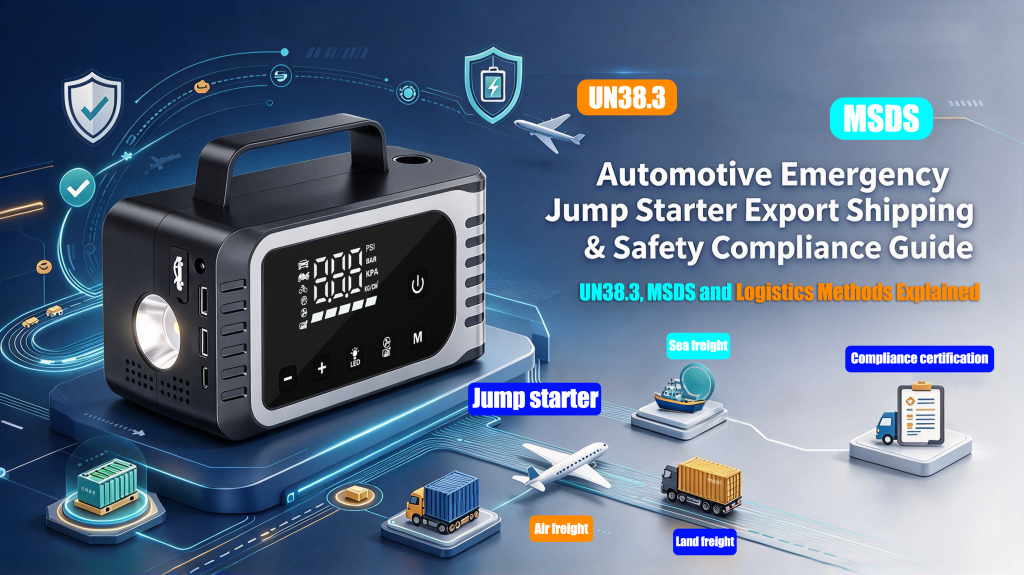
If you source car jump starters-also called car battery boosters or portable jump starters-from China for resale or fleet use, you already know one thing: these products don’t ship like ordinary electronics.
A 2000A peak jump starter may look like a power bank on steroids, but inside it sits a high-discharge lithium battery capable of cranking a V8 engine. That same energy density thatmakes it useful also makes it a regulated dangerous good under international transport rules.
Get the compliance paperwork wrong and your shipment gets held at customs, returned, ordestroyed. Get the packaging wrong and you’re looking at fines, cargo refusals, or worse-athermal incident in a container.
This guide breaks down exactly what B2B buyers need to know: why jump starters are classifiedas dangerous goods, what UN38.3 and MSDS/SDS actually cover, how sea freight, air freight,and express courier differ, and how to structure your supply chain to minimize risk and cost.
Why a Car Jump Starter Is Classified as DangerousGoods
The classification comes down to one component: the lithium-ion or lithium-polymer battery pack inside the unit.
Lithium batteries are assigned to UN 3480 (lithium-ion batteries, standalone) or UN 3481(lithium-ion batteries packed with or contained in equipment). A car jump starter falls under UN3481 because the battery is contained inside the device itself. However, if you ship spare battery packs separately, those are UN 3480 and face stricter limits.
Under both the IMDG Code (sea) and IATA DGR (air), lithium batteries are Class 9-Miscellaneous Dangerous Goods. This means they don’t fall into the more severe categories like explosives or corrosives, but they still require:
- A proper dangerous goods declaration
- Lithium battery handling labels and marks
- Compliance with watt-hour (Wh) and quantity limits per package
You’ll see suppliers advertise “20000mAh” or “32000mAh,” but transport regulators don’t careabout mAh.
They care about watt-hours (Wh), calculated as:
Wh = mAh÷1000 x Nominal Voltage
B2B takeaway: Always request the Wh rating and battery type (LiPo / LiFePO4) from your supplier before getting a shipping quote. mAh alone is meaningless for logistics.
UN38.3: The Battery Safety Test That's Non-Negotiable
UN38.3 refers to Section 38.3 of the United Nations Manual of Tests and Criteria, part of the Recommendations on the Transport of Dangerous Goods. It’s the global standard test suite that lithium batteries must pass before they can be transported by any mode-sea, air, or land.
Every battery cell and battery pack intended for transport must pass:
| Test | What It Simulates |
|---|---|
| T.1 Height Simulation | Low-pressure cargo hold conditions at altitude |
| T.2 Thermal Test | Rapid temperature cycling (-40°C to +75°C) |
| T.3 Vibration | Road / rail / sea vibration during transport |
| T.4 Shock | Impact and rough handling |
| T.5 External Short Circuit | Accidental short across terminals |
| T.6 Impact/ Crush | Mechanical damage to the cell |
| T.7 Overcharge | Charging beyond safe limits |
| T.8 Forced Discharge | Deep discharge beyond safe limits |
A passing result means the battery does not rupture, leak, vent, disassemble, or catch fireunder these conditions. The test report is issued by an accredited lab (e.g., SGS, TUV, Intertek,CTI) and is typically valid for the specific cell model and pack configuration.
Not all “UN38.3 reports” are equal. Before accepting one:
- Match the cell model. The report must cover the exact battery cell used in your unit. A report for a different cell doesn’t cover your product.
- Check the pack configuration. If your jump starter uses 4 cells in series (14.8V, the report must reflect that pack design-not a single-cell test.
- Verify the lab’s accreditation. Reports from unrecognized labs may be rejected by airlines or customs.
- Request the test summary, not just a certificate. The full report or at minimum the UN38.3test summary (per IATA DGR 2023+ requirements) should be available.
Common pitfall: Some suppliers provide a UN38.3 report for the cel/ but not for the finishedbattery pack. For air freight under IATA Section II, you need the pack-level test summary.Confirm both before shipping.
Demand MSDS/SDS: The Safety Data Sheet Your Importer Will
MSDS (Material Safety Data Sheet) is the older term; under the GHS (Globally HarmonizedSystem), the current standard is the SDS (Safety Data Sheet). Most freight forwarders andcustoms agents still use “MSDS” colloquially, but the document should follow the 16-section GHS format.
A proper SDS for a car jump starter covers:
- Product identification - model, battery chemistry, Wh rating
- Hazard identification - Class 9, lithium battery hazard statements
- Composition / ingredients - battery cell materials, electrolyte components
- First-aid measures - exposure to electrolyte, burns
- Fire-fighting measures - extinguishing agents, thermal runaway risks
- Accidental release measures - electrolyte spill, damaged battery handling
- Handling and storage - temperature ranges, charging precautions
- Exposure controls / PPE - gloves, eye protection
- Physical and chemical properties - voltage, capacity, energy density
- Stability and reactivity - conditions to avoid (heat, puncture, water)
- Toxicological information - electrolyte exposure hazards
- Ecological information - disposal considerations
- Disposal considerations - battery recycling regulations
- Transport information - UN number, proper shipping name, packing group
- Regulatory information - CE, RoHS, REACH status
- Other information - revision date, supplier contact
- Customs clearance: Many countries (EU, US, Australia, Japan) require an SDS for lithiumbattery imports.
- Warehouse acceptance: Amazon FBA, 3PL warehouses, and overseas fulfillment centers willrefuse stock without a valid SDS.
- Retail compliance: Chains and distributors' compliance departments will request the SDsbefore listing the product.
- Insurance: Product liability insurers may require the SDS to underwrite coverage.
Tip: The SDS should be issued by the manufacturer or an authorized chemical safetyconsultant, and it must be updated whenever the battery chemistry or product formulationchanges.
Sea Freight Vs. Air Freight vs. Express Courier
(LCL/FCL)
(General Cargo)
(DHL/FedEx)
The three main shipping channels have very different rules, costs, and lead times for lithium battery products.
Best for: Large orders, container-level shipments, cost-sensitive restocking.
- Governing rules: IMDG Code (International Maritime Dangerous Goods Code)
- Classification: UN 3481, Class 9
- Packing instruction: P903 for batteries contained in equipment
- Requirements: Dangerous Goods Declaration (DGD), UN-certified packaging, lithium battery mark + Class 9 hazard label, container placard
- Limits: No per-package Wh limit under normal provisions; carrier policies vary
- Lead time: 25-45 days depending on destination
- Cost: Lowest per-unit cost for volume shipments
Best for: Time-sensitive restocking, smaller volumes, high-value orders.
- Governing rules: IATA Dangerous Goods Regulations (DGR)
- Classification: UN 3481, Class 9Cost: 3-5x sea freight per unit
- Packing instruction: PI 967 Section II (batteries contained in equipment)
- Requirements: UN38.3 test summary, max 5kg net weight of batteries per package, lithium battery handling label
- State of charge: < 30% of rated capacity (recommended by many airlines)
- Lead time: 5-10 days
- Cost: 3-5x sea freight per unit
Best for: Samples, small trial orders, urgent spare parts.
- Governing rules: IATA DGR + each carrier's own lithium battery policy
- Requirements: UN38.3 summary + MSDS/SDS provided to carrier; per-package limits vary bycarrier
- Key constraint: Many couriers refuse high-Wh jump starters (>10oWh) or require a special DG account
- Lead time:3-7 days door-to-door
- Cost: Highest per-unit, but fastest for small quantities
Key risk: Airlines are the strictest enforcers. A missing UN38.3 summary or incorrect labelmeans immediate cargo refusal. Confirm carrier acceptance before handing over the package.
Packaging Requirements: What "Compliant" ActuallyLooks Like
Whether by sea or air, the packaging principles are the same: prevent short circuits, prevent accidental activation, and contain any potential leakage.
- Each jump starter in an individual non-conductive bag or blister pack
- Unit in the OFF state with transport insulation tab in place
- State of charge at 30%-50% for transport (not fully charged, not fully drained)
- UN 4G certified fiberboard box for dangerous goods (required for sea freight; strongly recommended for air)
- Inner cushioning: foam, corrugated inserts, or molded pulp to prevent movement
- Maximum gross weight per carton: typically 10-15kg for air freight compliance
Every outer carton must display:
- Lithium Battery mark (UN-approved white-and-black diamond)
- Class 9 hazard label (for sea freight and full-DG air freight)
- UN number: UN 3481
- Proper shipping name: "Lithium-ion batteries contained in equipment"
- Shipper and consignee name and address
- Package orientation arrows (if required)
- Net quantity of batteries per package
Overseas Warehouse Stocking vs Drop-Shipping
As a B2B buyer, you have two fulfillment models, each with different compliance implications.
- Pros: Fast delivery, lower per-unit shipping cost, better quality control
- Compliance:The warehouse can accept hazardous goods and lithium batteries. Submit UN38.3, MSDS/SDS and product certification documents first.
- Amazon FBA specifics: Products must meet IATA PI 967 Section II; each unit in retail-ready packaging
- Fees: Some warehouses charge a DG handling fee per pallet or per unit
- Pros: No inventory risk, no warehouse DG fees
- Cons: Slow delivery (15-30+ days), higher per-unit shipping, more customs friction per order
- Compliance: Each individual shipment must still comply with destination country import rules
Recommendation for B2B brands: Start with express samples to validate the market, then move to sea freight + overseas warehouse for volume. This balances compliance cost with delivery speed.
Product Liability Insurance and After-Sales Risk
Lithium battery products carry a unique liability profile. A thermal runaway event-while rare inproperly manufactured units-can cause property damage or injury. As the importer or brandowner, you may be held liable in your market.
- Product Liability Insurance with minimum coverage matching your market norm (typically$1M-$5M per occurrence for US/EU)
- Policy must explicitly cover lithium battery products (many general policies exclude them)
- Keep records of: UN38.3 reports, MSDS/SDS, factory inspection reports, batch/lot numbers, customer complaint logs
When sourcing, require your supplier to document:
- Aging test: Every unit undergoes 24-72 hour charge-discharge aging cycle before packing
- Drop test: Packaging and unit drop testing per ISTA standards
- Water resistance test: If claiming IP65/IP67, request test reports
- BMS function test: Over-charge, over-discharge, over-current, short-circuit, reverse-connection protection verified on every unit
- Lot traceability: Each unit has a serial number linking to production batch and cell lot
These records aren’t just for quality-they’re your defense in a liability claim.
Quick Compliance Checklist for B2B Buyers
Before you pay for a shipment, confirm you have:
| ✓ | Compliance Checklist |
|---|---|
| ☑ | UN38.3 test report covering the exact cell and battery pack configuration |
| ☑ | MSDS / SDS in 16-section GHS format, issued by manufacturer |
| ☑ | Wh rating confirmed (not just mAh) |
| ☑ | Battery chemistry identified (LiPo / LiFePO4 / Li-ion) |
| ☑ | Shipping mode selected (sea / air / express) with matching packing instructions |
| ☑ | UN 4G certified packaging for sea freight |
| ☑ | Lithium battery labels and Class 9 hazard labels applied |
| ☑ | Dangerous Goods Declaration filed (sea / full-DG air) |
| ☑ | State of charge at 30%–50% before shipping |
| ☑ | Product liability insurance covering lithium batteries |
| ☑ | Batch traceability records from the factory |
| ☑ | Destination country certifications (CE / FCC / RoHS / UKCA / PSE, etc.) |
Conclusion
Shipping car jump starters isn’t complicated-it’s just document-intensive. The suppliers whotreat compliance as an afterthought are the ones whose cargo gets held at customs. The oneswho provide UN38.3 pack-level reports, GHS-format SDS, and UN-certified packaging are theones you can build a long-term B2B brand with.
If you’re evaluating jump starter suppliers, ask for these documents before you place a trialorder. A factory that can produce them within 48 hours is one that ships regularly and knows
the rules. A factory that hesitates or offers “a similar report for another model” is a red flag.
GEHOPW specializes in car jump starters. Proficient in battery-related hazardous goods rules and cross-border shipping requirements, we provide mature, reliable end-to-end transport solutions to secure cargo during transit. Reach out to us for detailed quotations and customized shipping solutions.
