


What Exactly Is a Car Jump Starter?
A car jump starter is a portable battery pack designed to deliver a very high current pulse – typically 500-2000 amps – to a vehicle’s starter motor when the onboard battery is too weak to crank the engine. Unliketraditional jumper cables that need a second running vehicle, a lithium jump starter is self-contained: charge it, store it in the glove box, and use it anywhere.
The core engineering challenge is simple to state and hard to solve: a device smallenough to fit in a glovebox must deliver enough current to turn over a cold engine, while remaining safe to handle, charge, and
store in a hot car interior for years.
1.Core Components: What Is Inside the Box
Every lithium jump starter contains five subsystems working together. Understanding each one helps you
evaluate product quality and compare supplier specifications.
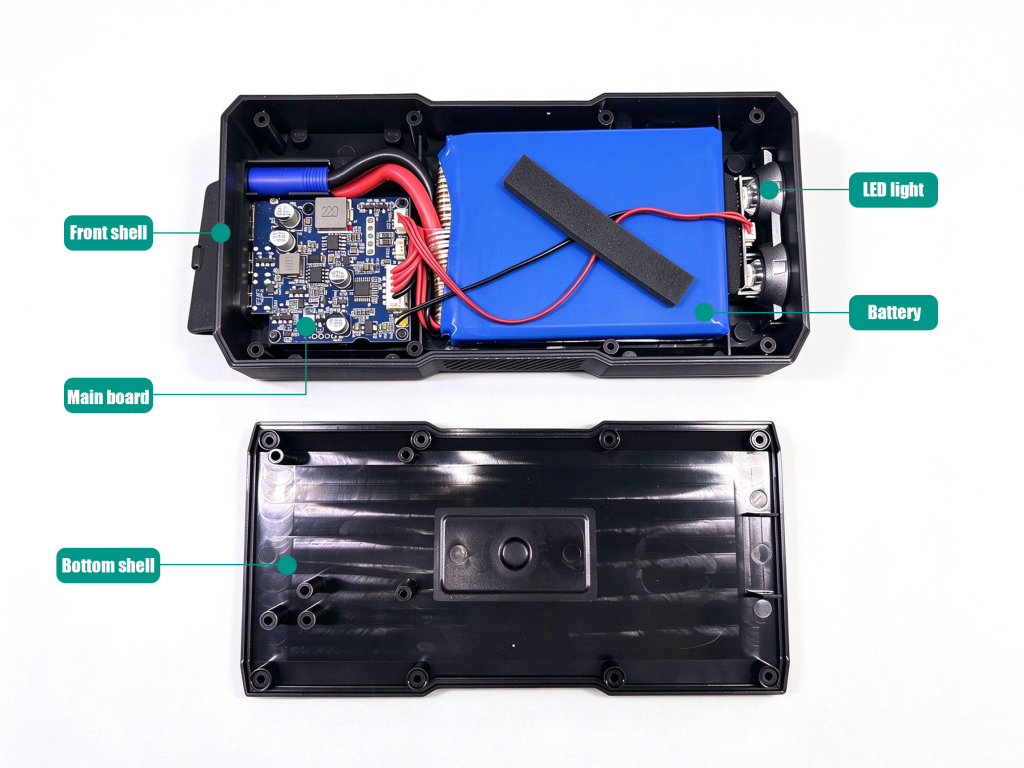
1Lithium Battery Pack
This is the core property of this type of cell. It supports continuous/peak discharge at 60C or even higher rates, and can instantly output large current of hundreds of amperes. It fully meets the instantaneous high current requirement of automotive starter motors and serves as the core technical support for jump starter products.
2BMS (Battery Management System)
Monitors each cell's voltage, temperature, and current. Cuts off discharge on over-current, short-circuit, over-temperature, or cell imbalance. The BMS is what prevents the battery from catching fire during a short.
3Main Control PCB
Houses the MCU (microcontroller), MOSFET power switches, DC-DC converter for USB output,They jointly control and protect the safety of the battery and the whole product.
4Smart Jumper Clamps
Not just wires — the clamp assembly often contains a secondary protection circuit with reverse-polarity detection, anti-spark circuitry, and a status LED. Quality clamps use pure copper jaws and 10AWG cable.
5Housing & Thermal Design
ABS or PC+ABS shell with internal flame-retardant barriers. Vents or heat-conductive pads dissipate the heat generated during high-current discharge. A housing that melts during use is a clear quality failure.
6User Interface
LED or LCD display showing battery percentage, voltage, and error codes. Power button, USB output ports, and LED work light. The display is also a diagnostic tool — error codes tell you why a start attempt failed.
he secret is not capacity — it is ultra-low internal resistance combined with high discharge C-rate. Take a typical 2500 mAh jump starter pack: fully charged at 16.5V, with only ~8 mΩ total internal resistance. By Ohm’s law, that opens the door to ~2000A of theoretical current. But what makes that safe and usable is the high-rate cell chemistry, rated 60C peak pulse — meaning the cells can actually deliver 250A+ per pack continuously for 3–10 seconds without overheating. The BMS and MOSFET array then cap the cranking pulse at 1000–2000A to protect both the cells and the user. This is why a pocket-sized pack can start an engine: it is not about big capacity, it is about a combination of low resistance for current flow and high C-rate to withstand it.

Cells are arranged in a series-parallel combination:
- Series (S): Adds voltage. 4 cells in series = 14.8V nominal (4 x 3.7V). This matches the 12V vehicle electrical system.
- Parallel (P): Adds capacity and current capability. 2 cells in parallel doubles the mAh and the maximum safe discharge current.
- A typical configuration is 4s1P (4 series, 1 parallel) = 14.8V, -4,000 mAh, capable of 1000-2000A continuous.
Virtually all Car Jump Starters on the market use high-rate lithium polymer (LiPo) cells – notstandard phone batteries, and not prismatic LiFePO4 cells. Here is why this chemistry dominates the category:
| Feature | High-Rate LiPo Advantage |
|---|---|
| Ultra-high discharge rate | Up to 60C continuous, 120C+ pulse — delivers hundreds of amps from a compact pack. Standard Li-ion (5C) cannot do this without overheating. |
| Flexible form factor | Pouch format fits any device shape — that is why jump starters are thin, rectangular, and pocket-sized, not cylindrical brick-like objects. |
| High energy density | ~200 Wh/kg means more power in less weight. A 1000A peak unit weighs only 1–2 kg — carryable with one hand. |
| 3.7V nominal per cell | 4S configuration = 14.8V, perfectly matched to 12V vehicle systems. No need for extra cells or a boost converter. |
| Instant power delivery | Low internal resistance ensures minimal voltage drop under heavy load, critical for 3–5s cranking pulses. |
| Mature safety design | With a proper BMS, flame-retardant packaging, and high-quality separator film, modern high-rate LiPo is safe for automotive emergency use. |
3.The Complete Start-Up Sequence
What happens from the moment you clamp onto a dead battery until the engine roars to life? It is a carefully choreographed 5-step process that happens in seconds.
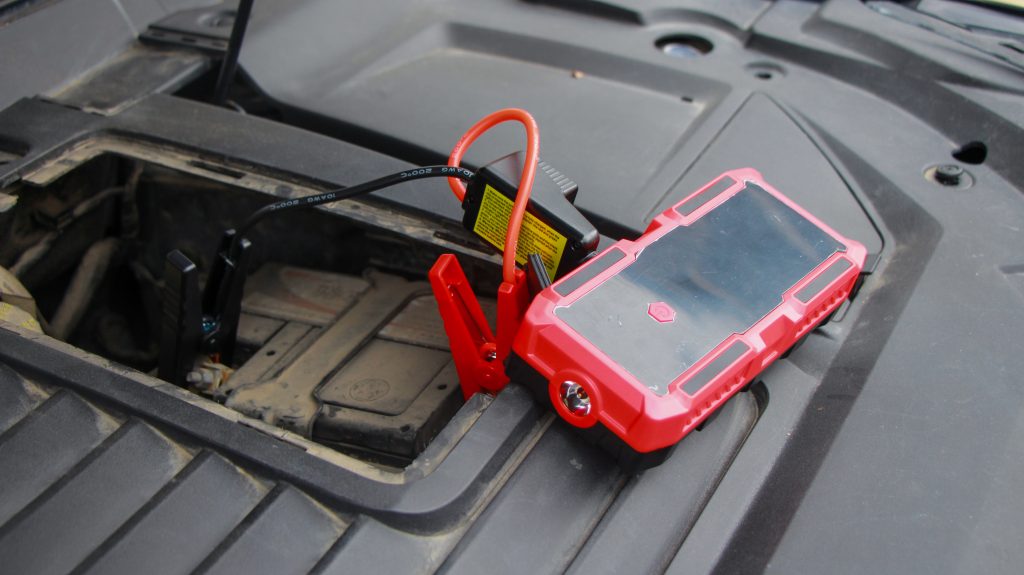
Detection & Safety Check
The smart clamp's microcontroller detects the vehicle battery voltage and polarity. If the clamps are reversed, the circuit blocks current and flashes a red warning. If the vehicle battery is below ~2V (fully dead), some units enter "Force Start" or "Override" mode to bypass detection.
Pre-Charge (Anti-Spark)
Before opening the main power path, the unit slowly charges the vehicle battery and the input capacitors through a current-limited resistor. This prevents the spark and welding that would occur if a fully charged pack were directly connected to a deeply discharged battery.
Main Power Path Opens
The MOSFET array on the main PCB switches fully on. Now the jump starter's battery is directly connected to the vehicle battery in parallel. The combined voltage rises to ~12.4–12.8V, enough to engage the starter solenoid.
High-Current Cranking
When the driver turns the key, the starter motor draws 1000A (gasoline) or 2000A (diesel). The jump starter's high-drain cells deliver this pulse for 3–10 seconds. The BMS monitors current and temperature in real time, cutting off if limits are exceeded.
Engine Starts — Disconnect
Once the engine runs, the alternator begins charging the vehicle battery. The user disconnects the clamps within 30 seconds to avoid back-feeding alternator voltage into the jump starter. Quality units have over-voltage protection that tolerates brief alternator spikes up to 14.8V.
4.Key Technical Parameters Explained
Spec sheets are full of numbers. Here is what actually matters when comparing products for your market.
| Parameter | What It Means | Buyer's Check |
|---|---|---|
| Peak Current | Maximum instantaneous current the unit can deliver, usually for 0.3–1 second. | Ask for the test standard. "2000A peak" without a duration or temperature specified is marketing, not engineering. |
| Starting Current | Current the unit can sustain for 3–5 seconds during actual cranking. | This is the real number. A unit with 1000A starting current outperforms one with 2000A peak but only 500A starting. |
| Capacity (Wh) | Total energy stored. Watt-hours = volts × amp-hours. | Compare in Wh, not mAh. mAh alone is meaningless without knowing the voltage. |
| Input Voltage Range | The vehicle battery voltage range in which the unit will operate. | A good unit works down to 0V (fully dead battery) via override mode. Cheap units refuse below 3V. |
| Operating Temp | Temperature range for reliable starting. | Critical for northern markets. Verify -30°C performance with actual test data, not just spec sheet claims. |
Common Technical Myths
These misconceptions lead buyers to choose the wrong product. Share this with your sales team.
"Higher mAh means more jump starts"
Not necessarily. A 20,000 mAh pack using low-drain cells may overheat and shut down during cranking. An 8,000 mAh high-drain pack may deliver more successful starts. Cell C-rate matters more than total capacity.
"Peak current = the current that starts the car"
Peak current is a sub-second spike. The engine actually cranks on starting current sustained for 3–5 seconds. Always compare starting current, not peak current, when evaluating diesel or cold-climate performance.
"All jump starters are basically the same inside"
The real difference between an entry-level unit and a commercial-grade unit is in cell grade, MOSFET quality, BMS sophistication, and clamp protection. The budget unit may work once — and fail on the second or third start due to thermal cutoff.
"Lithium jump starters are dangerous in hot cars"
Quality units using grade-A high-rate LiPo cells, flame-retardant packaging, and a proper BMS are safe at cabin temperatures up to 60°C. The risk comes from cheap units using unbranded cells with no thermal protection. Always verify UN38.3 and IEC 62133 certification.
From cell grade to MOSFET switches, from BMS protection to thermal design — every hidden detail determines whether a jump starter starts an engine on the first try, when it matters most.Need a factory-direct partner with verified test reports and OEM customization? Get in touch for samples.
